PixelPals Haven
Opening the next view…
Preparing the page without changing your saved work.
 Gear intelligence for complete setups
PixelPals Haven
Preparing the page without changing your saved work.
Flight-sim setup guide
Improve control, visibility and workflow in the order that solves a measured limitation instead of buying panels before the foundation is stable.
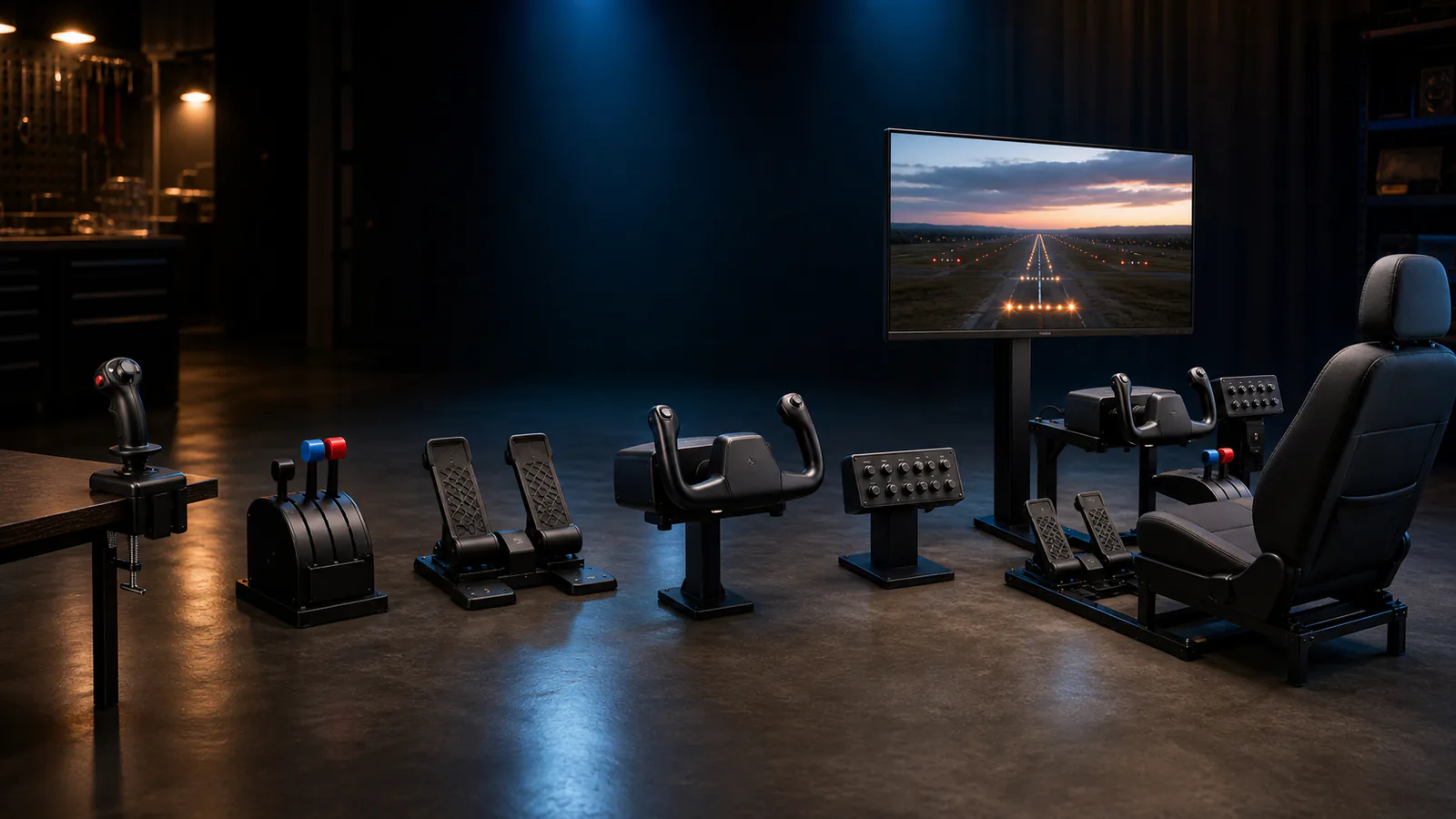
The first upgrade should be chosen by the aircraft and simulator that receive most of the flying time. A general-aviation pilot may gain more from a yoke and rudder pedals. A DCS pilot may gain more from a stick, throttle and head tracking. An airliner pilot may prioritize a quadrant, autopilot controls and readable displays.
Write down the current limitation in a sentence. Examples include: the aircraft cannot be controlled smoothly, the pilot cannot see the pattern or instruments, engine controls require too much keyboard work, or the desk changes position during every session.
Start with reliable pitch and roll control and a mount that does not move. A basic stick can be a better first purchase than an elaborate panel because it affects every second of the flight. If the current yoke or stick drifts, has a large deadzone or cannot be mounted comfortably, solve that before adding secondary controls.
A separate throttle or quadrant reduces keyboard dependence and makes power changes repeatable. Choose the number of axes and detents around the aircraft rather than buying the largest unit. Piston, turboprop, airliner and combat aircraft use different controls.
Dedicated pedals become a high-priority upgrade for helicopters, taildraggers, crosswind practice, coordinated flying and differential braking. They are lower priority when the aircraft is stable, yaw assistance is acceptable and the twist axis is not causing a problem.
Head tracking, a larger or wider display, multiple monitors or VR can improve situational awareness. Choose the method by instrument readability, graphics performance, comfort and interaction with physical controls. A view upgrade should be tested in the most demanding aircraft and scenery, not only in a simple training flight.
Autopilot, radios, gear, flaps and navigation controls are strong candidates because they are used frequently. Aircraft-specific overheads and replica panels should follow only when the aircraft family is stable enough to justify dedicated labels and mounting.
A fixed frame locks in seat position, control geometry, display distance and service access. Use temporary mounts and measured reference positions first. Once the layout has survived several aircraft and long sessions, build permanent panels and cable paths around it.
Published .